With things moving at a faster pace, we are returning to quarterly newsletters to bring you all the updates from the world of diversity. Here is what we have been up to recently.
News
Reading Group Blueprints are out!
As planned, we have now released nine Reading Group Blueprints, allowing students to easily set up reading groups on topics not taught at their universities. The topics were selected based on Annie McCallion’s AHRC-funded research project – you can read a report from her analysis of the curricula from the top 10 UK departments right here. We are thankful to AHRC, the Future of Work and Income Research Network, the Centre for Ethics, Philosophy and Public Affairs and the School of Philosophical, Anthropological and Film Studies at St Andrews for their generous funding.
We are excited that one of our blueprints is already in use! The creators of Sex, What Is It Good For? are running a reading group at the University of St Andrews. We are looking forward to seeing more groups starting around the world and invite you to promote the idea with your students, colleagues and friends!
More Blueprints incoming
We are also already working on the next expansion to our Blueprints. We will be releasing a new batch in May/June, in time for the summer trimester on the northern hemisphere. If you would like to join our team and have an idea for a Blueprint focused on one of the topics suggested by our research, have a look at the guidelines we compiled and get in touch!
Our first Minorities and Philosophy rep
We are expanding our collaboration with MAP chapters by promoting a new role: DRL Reps. The idea is simple: a Rep is a member of a MAP chapter who collaborates closely with the DRL, developing joint initiatives such as local workshops or Contribution Drives, accessing local funding for collaborative projects, running groups using our Blueprints, and other initiatives developed to suit particular needs and opportunities. Our first Rep, Atul Satija (University of St Andrews), has joined us recently, and we are looking forward to inviting more students to take on this role at universities around the world!
Site updates
We have updated our About section to include new data published in the version of the BPA/SWIP UK report by Jenny Saul and Helen Beebee, and elsewhere. We are happy that we could contribute to the understanding of under-representation in teaching through Annie’s research and we are hoping to further expand on our knowledge of under-representation in philosophy by conducting similar research projects in the future.
One hundred contributors!
Early this year, we have breached the magic number! Over one hundred people have now contributed new content to the DRL. We would like to offer big thanks to all of our generous contributors, and to invite you all to do the same and send us more content for the list through our Contribution Page.
Volunteer Spotlight: Sara Peppe
I am a PhD researcher at the University of York currently working on probability in Quantum Mechanics (QM). Also, my current researches look at the theme of artificial intelligence in medicine. In particular, I am focusing on the deployment of artificial intelligence in healthcare, looking at the African context.
Before starting my PhD career at York, I was awarded a Masters degree at the University “Federico II” of Naples, in Italy.
My involvement with the Diversity Reading List can be traced back to 2018. I received an email from my department talking about the DRL. I was very interested in the project and wanted to leave a mark by becoming a volunteer. In this way, I started my volunteering activity as a contributor. I found it very rewarding. I felt that with my little contribution we were all moving forward towards a more inclusive academic environment.
After several years as an editorial assistant, I became the editor of the Diversity Reading List. Thus, I had the opportunity to become even more involved in the project. This year I helped launch our Blueprint project which aims to provide the necessary resources for study groups on philosophical traditions other than the Western Analytical one and feature themes often neglected in the UK philosophy departments. All together we made another little step forward in our journey towards inclusive philosophy.
Get involved, get funded!
We continuously expand our list and you can help us by contributing papers via our contribution page.
We couldn’t do what we do without the help of our fantastic volunteers. If you would like to join them and volunteer for us please get in touch! There are so many ways to get involved: creating new Reading Group Blueprints; adding new list entries; helping us with small one off jobs; becoming a regular editor; and promoting the DRL at events and online.
You might even be able to access funding to support your time working on the DRL. We’re keen to support any volunteers in getting this kind of funding. You can read more about this here.
Thanks so much again for all your support,
The DRL Team

 I’m a PhD student at the University of North Carolina at Chapel Hill, writing a dissertation on reasoning and inference. Before that, I did undergraduate and masters degrees at the Universities of Durham and Oxford, respectively. I’ve been involved with the DRL for just over a year, as an Editor Assistant in Asian Philosophy, Epistemology, and Logic. I’ve also just finished an APA-funded project, working with Clotilde Torregrossa on expanding the DRL’s database with 351 texts contributed by the public. It’s great to see people taking up the call to contribute to the DRL; consistent public contributions will really help take things to the next level.
 Even though academia is in theory directed at the (equal) dissemination of knowledge and education, in reality this is, very often, not the case. I’m interested in and getting involved with equality, diversity and decolonization issues because I think this is a way to challenge the problems we are having in a neoliberal, capitalist university-system, and to provide a more equal and accessible space within philosophy to discuss these issues; while of course we also need to continuously reflect within these spaces how we actually are addressing and meeting various problems of exclusion people face.
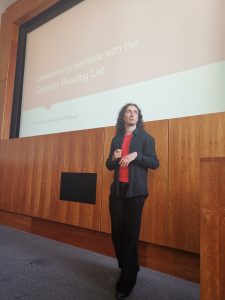 We collaborated with the MAP chapter at St Andrews and Stirling to put up a
 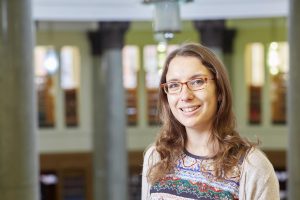 I am a Teaching Fellow in medical ethics at the University of Leeds. I have just completed my PhD on the nature of the romantic relationship and the legitimacy of a political institution of marriage. I am currently an Assistant Project Manager for the DRL, but I first got involved back in 2014/15 when Simon Fokt was setting up the project in Leeds. Initially I didn’t feel confident enough to review papers and produce entries for the website – I had only just got back into academic philosophy after a few years in the ‘real world’, and I hadn’t yet started teaching. Luckily there was still loads for me to do. I had a background in writing grant applications for charities, and so I started writing them for the DRL. I also started helping with the promotion of the project online and at events. And that’s what I continue to do today five years later!
